Course: Software Technology in Cyber-Physical Systems

Brief Summary
This course introduces students to software and system architecture for cyber-physical systems (CPS). Students learn to design, document, and implement CPS architectures using relevant diagrams and recognized design patterns. The course emphasizes system integration, software component development, and performance testing. Through hands-on exercises, students apply software design and software quality theory to create CPS solutions and demonstrate their ability to analyze, develop, and validate system designs.
Location
The Faculty of Engineering, University of Southern Denmark, Odense, Denmark
Responsibilities
Teaching Assistant (TA) for international bachelor students in software technology for cyber-physical systems.
Responsible for creating, conducting, and assisting students with lab exercises.
Date(s)
2022 Spring, 2021 Spring
ECTS Value
7
Class Size
~25 students
Exam Style
Portfolio
Course Code
T500016101
External Link
https://odin.sdu.dk/sitecore/index.php?a=searchfagbesk&bbcourseid=T500016101-1-F22&lang=en
Course: Object-Oriented Analysis, Design and Programming

Brief Summary
This course introduces fundamental object-oriented programming concepts, including classes, objects, inheritance, polymorphism, interfaces, exceptions, collections, UML, and application structuring in Java. Master students progress through modules covering core programming constructs, data structures, error handling, and software design principles. Emphasis is placed on analyzing specifications, designing class diagrams, implementing object-oriented programs, and reflecting on design decisions. Learning is reinforced through lectures, exercises, and a mandatory portfolio of assignments and a final project, followed by an individual oral exam.
Location
The Faculty of Engineering, University of Southern Denmark, Odense, Denmark
Responsibilities
Teaching international master students in Object-oriented Programming using Java.
Responsible for planning, teaching, and creating the teaching material (lectures, exercises, assignments, additional material), and conducting the exam.
Date(s)
2026 Fall, 2023 Fall
ECTS Value
5
Class Size
28 students
Exam Style
Oral Exam
Course Code
T610037101
External Link
https://odin.sdu.dk/sitecore/index.php?a=searchfagbesk&bbcourseid=T610037101-1-E23&lang=da
Teaching Philosophy
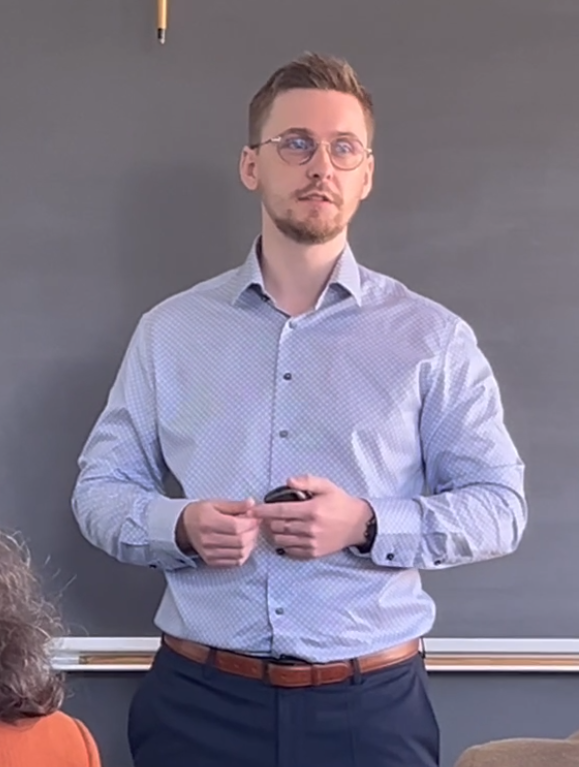
My teaching philosophy is grounded in constructive alignment principles1, where teaching, learning activities, and assessments are purposefully designed to support the intended learning outcomes. I believe that good teaching creates a structured, motivating, and engaging environment where students are challenged to take responsibility for their own learning, while also receiving guidance and support to succeed.
1 Biggs, J., & Tang, C. (2011). Teaching for Quality Learning at University: What the Student Does (4th ed.). Maidenhead, UK: McGraw-Hill/Open University Press.
The following principles guide my teaching practice:
- Preparation and clarity: I prepare thoroughly for each class and ensure that students are aware of the expected learning outcomes for both the course and individual modules. This helps students focus on the most important aspects of their learning.
- Student responsibility and teacher responsibility: I believe students in higher education are primarily responsible for their own learning. However, my role as a teacher is to inspire, motivate, and stimulate their curiosity, while providing structure and support where needed.
- Balance of theory and practice: I typically divide my teaching into 50% lecturing with active student engagement and 50% lab exercises. This allows students to apply knowledge directly and develop practical skills alongside theoretical understanding.
- Development of competences: To encourage deeper learning, I assign more extensive projects that require students to integrate knowledge and skills from multiple modules. This prepares them to tackle new and complex problems.
- Feedback as a learning tool: I actively use feedback in my teaching. In class, I employ questioning and mini tasks to check understanding before introducing more advanced topics. On written assignments, I provide detailed feedback so students can improve their abilities. I also invite formal mid-semester and end-semester feedback from students, which I use to reflect on and improve my teaching.
- Attention to diverse student needs: From experience, I know that students vary in ambition and ability. I make an effort to support less confident students while also offering ambitious students opportunities to go beyond the course objectives through additional material.
In summary, my fundamental pedagogical view is that good teaching should be well-prepared, structured, motivating, and flexible enough to address diverse student needs. It should balance theory with practice and encourage students to take responsibility for their learning, supported by feedback and clear guidance.